
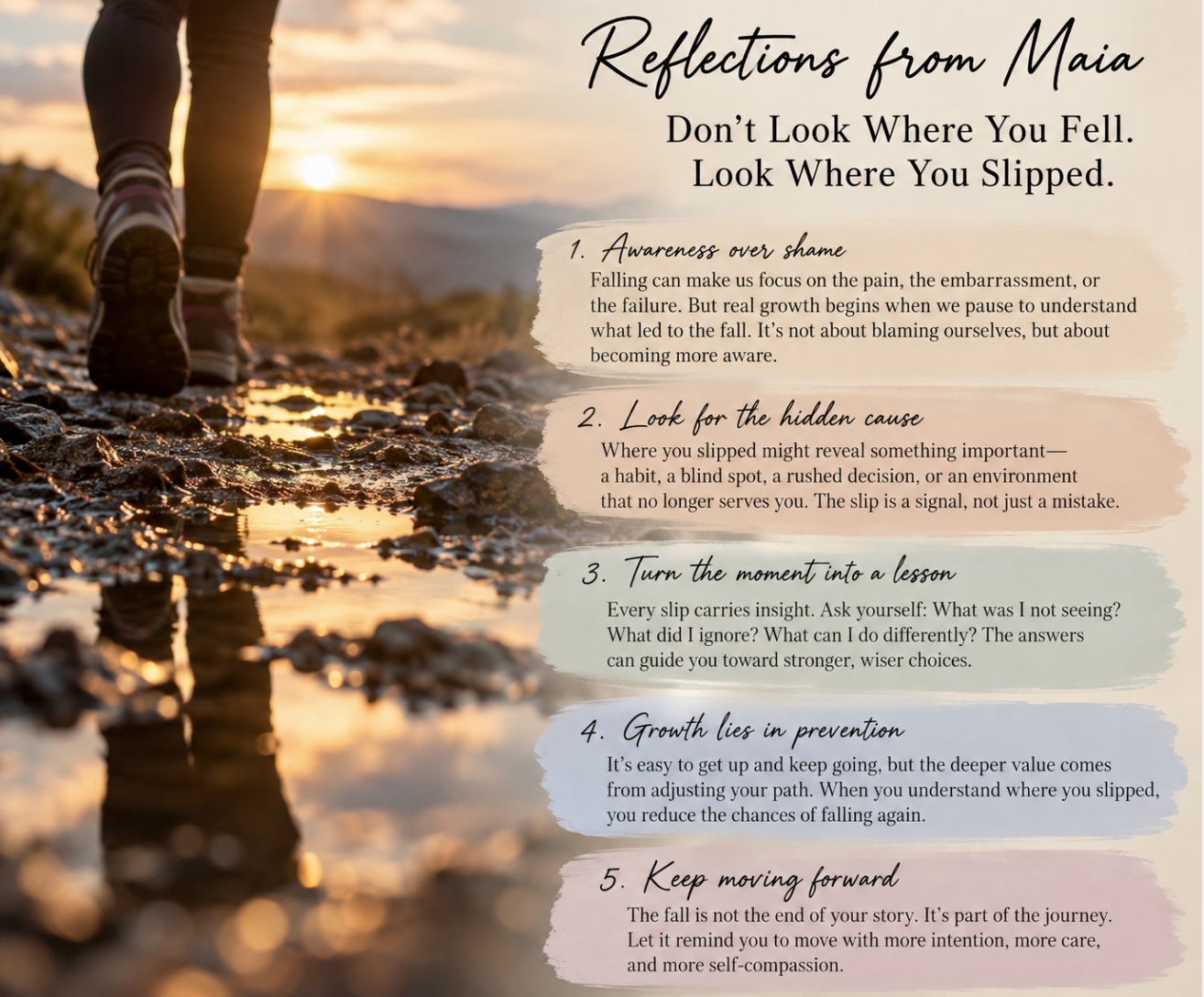
Do not look where you fell, but where you slipped
There’s a proverb often attributed to African wisdom: “Do not look where you fell, but where you slipped.”
That stopped me.
Because when something goes wrong, our natural tendency is to focus on the outcome.
The failed relationship.
The missed opportunity.
The financial mistake.
The poor decision.
The disappointment.
The embarrassment.
The obstacle we didn't anticipate.
The place where everything seemed to fall apart.
But the place where you fell may not be where the problem actually began.
Sometimes wisdom requires us to go backward and ask:
Where did I slip?
Don't Just Study the Outcome
Maybe I ignored a warning sign.
Maybe I made an assumption.
Maybe I moved too quickly.
Maybe I didn't have all the information.
Maybe I trusted something I should have verified.
Maybe I allowed emotion to override discernment.
Maybe I knew something didn't feel right but continued anyway.
Maybe there was nothing I could have done differently—but there's still something the experience can teach me.
This is where my quality mindset kicks in.
When something goes wrong, I'm rarely satisfied with:
“Someone made a mistake.”
Okay.
But what empowered the mistake?
What conditions were present?
What allowed it to progress?
What could have detected it sooner?
And what needs to change to reduce the likelihood of recurrence?
Life deserves some of that same root cause analysis.
Not so we can spend our lives investigating everything we've done wrong.
But because experience should eventually produce wisdom.
A Mistake Should Become Information, Not Identity
Sometimes the person who has the hardest time forgiving us...
is us.
We replay the failure.
Revisit the decision.
Remember what we should have done.
Think about what we wish we'd known.
And keep returning to the place where we fell.
But how long are you going to stand there?
You made the mistake.
You experienced the consequence.
You learned something.
Now apply it.
A mistake should become information, not identity.
You are allowed to become wiser than the version of yourself who made that decision.
You are allowed to establish a boundary because of what you learned.
You are allowed to ask better questions.
You are allowed to recognize warning signs sooner.
You are allowed to change your mind when new information becomes available.
That's not inconsistency.
That's growth.
Discernment Matters More Than Ever
And today, discernment isn't limited to our personal decisions.
We are surrounded by information.
Headlines.
Photographs.
Videos.
Advertisements.
Social-media posts.
Podcasts.
Text messages.
Emails.
Rumors.
Opinions presented as facts.
And increasingly sophisticated attempts to manipulate what we believe.
Something can reach us in seconds and create an immediate emotional response.
But emotion can move faster than discernment.
A photograph captures a moment, not necessarily the entire context.
A video clip can begin after something important happened and end before something equally important occurs.
A headline can influence our opinion before we've read the article.
A rumor can travel farther than its correction.
And hearing something repeatedly can make it feel true without making it factual.
That's why vigilance matters.
Not paranoia.
Discernment.
Pause Before You React
Proverbs 14:15 reminds us:
“The simple believe anything, but the prudent give thought to their steps.”
Everything presented to me doesn't require immediate belief.
Everything that angers me doesn't require an immediate response.
Everything someone sends me doesn't require another share.
Everything trending isn't true.
Everything confidently stated isn't factual.
Everything that confirms what I already believe isn't automatically accurate.
And everything labeled as faith isn't necessarily sound doctrine.
Sometimes wisdom says:
Pause.
Look again.
Read further.
Check the source.
Consider the context.
Ask another question.
Pray.
Listen.
Discern.
Because one of the easiest ways to manipulate people is to get them to react before they think.
Check Your Own Confirmation Bias
And here's where it gets uncomfortable.
Fact-checking isn't only necessary when someone sends us something we disagree with.
Sometimes we need to investigate information we want to believe.
Whew.
Because confirmation can feel a lot like truth when it reinforces something we've already decided.
That applies to relationships.
Leadership.
Politics.
Faith.
Work.
Social media.
And even the stories we tell ourselves.
Am I seeking truth?
Or am I collecting evidence to support the conclusion I've already reached?
There's a difference.
Stay Centered
For me, discernment also requires staying spiritually grounded.
There are too many voices competing for my attention to allow all of them equal influence.
I have to continually return to God.
What does Scripture actually say?
What is the context?
Does what I'm hearing align with God's character?
Am I operating from wisdom or fear?
Am I listening—or merely waiting for something that confirms what I want?
Keeping my eyes, ears, mind, and heart open doesn't mean believing everything.
It means remaining teachable enough to examine what enters them.
Discernment requires more than open eyes. It requires a centered heart.
Work the Ground in Front of You
Proverbs 12:11 says: “Those who work their land will have abundant food, but those who chase fantasies have no sense.”
There's something powerful about staying grounded.
Tend what's actually in front of you.
Do the work.
Seek truth.
Ask questions.
Learn.
Correct.
Improve.
Grow.
Don't chase every distraction.
Don't follow every voice.
Don't repeat every rumor.
Don't allow every failure to define you.
And don't spend so much time staring at where you fell that you miss what the fall was trying to teach you.
If you fell...
get up.
If you slipped...
figure out why.
If you were wrong...
correct it.
If you learned something...apply it.
And if life charged you an expensive tuition for the lesson...
baby, don't waste the education.
“A mistake should become information, not identity.” — Maia Treleaven
And perhaps the question worth carrying today is: Don't just ask where you fell. Ask where you slipped.
Because the fall tells you what happened.
Understanding the slip may help you understand why.
And wisdom helps determine what you do differently next time.
Reflections from Maia™
Faith · Purpose · Leadership · Life